Novel Monitoring Features to Scale Mangrove Restoration
Read Now



January 31, 2024

Earlier this month the World Economic Forum’s Annual Meeting took place in Davos, Switzerland bringing together top decision-makers to address major global issues and priorities for the year ahead. With more than 300 public figures present, the meeting focused on rebuilding trust amid uncertainty and rapid change, which included a deep-dive on artificial intelligence as a driving force for the economy and society and a long-term strategy for climate, nature and energy.
This topic is especially close to us at veritree. In early 2024, we initiated an R&D collaboration with the University of British Columbia to explore the use of computer vision and AI in tree survival assessment, an area where traditional evaluation methods have historically been slow and manual. Here's what that research involved.
Our innovative computer vision model is designed to estimate survival rates by analyzing photographs and videos to identify which trees within the frame are dead or living. In collaboration with the University of British Columbia, we’re working to establish a scalable methodology for assessing survival rates of various tree species. How are we doing it? We’ve taken more than 25,000 photos and employed Convolutional Neural Networks (CNNs) to develop algorithms capable of identifying live and dead trees at different growth stages. Our initial focus has been on mangroves and has involved training the algorithms with smartphone images captured by our planting partners in Kenya.
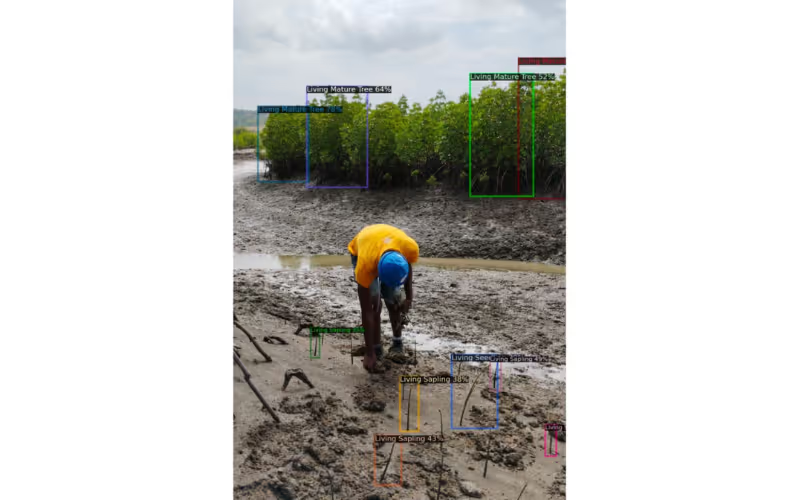
Expanding beyond mere survival assessment, we’re also looking to extract valuable information from each image, including mangrove species, leaf counts on living mangroves, diameter at breast height, tree height, planting density, and the number of propagules on a tree. These CNN models will then be adapted for broader applications for non-mangrove tree planting projects in North America and Rwanda. Incorporating computer vision into tree survival rate estimates allows for the efficient surveying of larger tree populations, providing planting and conservation projects with a more comprehensive understanding of the potential impact of restoration interventions.
It is our belief that accurate tree identification and survival estimates achieved through our scientific approach will instil confidence in the concepts of additionality and permanence for carbon sequestration. Furthermore, this methodology supports the development of robust monitoring systems essential for sustainable forest management. By embracing cutting-edge technology, like Generative AI, we can not only enhance the efficiency of monitoring reforestation, but also the establishment of more resilient and sustainable forest ecosystems. We can’t wait to share more as this research and methodology evolves.
PREV BLOG