From Spores to Sea Forests
Read Now



February 19, 2026

Seaforestation is an emerging restoration approach focused on rebuilding kelp forests that support biodiversity, improve water quality, and play a role in ocean-based climate solutions. Unlike trees, kelp grows quickly, creates complex habitat, and forms the backbone of nearshore food webs along the Pacific coast.
Kelp naturally begins its life in the ocean, but when restoration needs to happen at scale and on reliable timelines, parts of that lifecycle are increasingly supported on land. That’s why veritree, together with Industrial Plankton, GreenWave, Sea Forest Macro Algae, and the Indigenous-led United Kelp Cooperative, invested in building a dedicated sea forest hatchery and nursery on British Columbia’s Vancouver Island. Hatcheries allow early growth stages to occur under controlled conditions, so young kelp can be planted when ocean conditions are right.
As our seaforestation partner Kristina Long explains:
“Kelp seed supply is a big gap in the industry, and quality varies among the hatcheries we have sourced from. That variability is a big risk for any farming operation. Having secure, stable, healthy access to seed is a vital component of any farming business.”
This hatchery is designed to do one critical thing: reduce risk in kelp restoration by controlling the earliest and most fragile stages of the kelp lifecycle.
Before any kelp could be grown, the team had to solve a fundamental challenge: how to bring ocean water into a land-based facility without introducing contaminants that could harm early life stages.
The hatchery now runs on a fully contained seawater processing system built into a 40-foot sea container. Seawater is collected offshore using a truck-mounted tank and pump, then processed through a combination of:
Each batch runs through this system before entering the hatchery or nursery. All tanks, pipes, and equipment undergo repeated washing, disinfecting, and rinsing cycles before use.
This level of control is essential. Early kelp life stages are microscopic and extremely sensitive to contamination and environmental change. If conditions aren’t right, entire cultures can fail.
As Hatchery Manager, Paul Gonzales, puts it:
“The purpose is to be able to completely control the lifecycle of the kelp we want to grow at the farm: from reproductive tissue collected in the wild, to spores, to gametophytes, to sporophytes, and finally onto seed string that we can outplant once they reach a large enough size.”
Kelp seed begins with spores collected from wild kelp during a limited window between late summer and fall. Teams carefully harvest sorus tissue, the spore-producing patches on kelp blades, clean it under sterile conditions, and dry it overnight to trigger spore release the next day.
Those spores are then grown into gametophytes, the microscopic first stage of kelp’s lifecycle.
Under the right conditions, gametophytes can be maintained indefinitely while undergoing asexual reproduction. This allows the hatchery to maintain a consistent supply of kelp seed across growing seasons and over multiple years.
Today, the hatchery maintains over 150 live gametophyte cultures across two kelp species:
These cultures are stored at 10°C under red light to prevent sexual reproduction and are regularly monitored for health and contamination. This effectively creates a long-term seed bank, allowing the team to start new production runs without relying entirely on unpredictable wild collection each year.

Paul explains why that matters:
“If we control the lifecycle entirely in this facility, we’re no longer subject to seasonal variability. We can produce when we want, in the quantities we want, and for the species we want.”
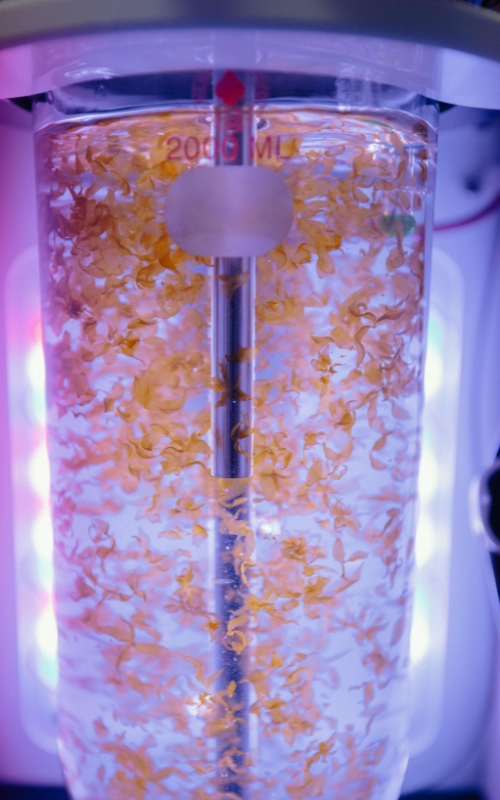
Once the strongest gametophyte cultures are selected, they move into Seaweed Bio-Reactors (SBRs). In the SBRs, gametophytes are kept in suspension and can be shredded to promote vegetative growth, while light, temperature, pH, and circulation are all controlled and continuously monitored.
After several weeks, cultures are induced, using blue light, to transition into sporophytes, or young kelp plants. At that point, they’re ready to be transferred onto seed string.
Using a hydrophilic braided twine developed by GreenWave and Hortimare, technicians literally paint the cultures onto spools by hand, ensuring even distribution. Each spool is then placed into nursery tanks supplied with filtered, UV-treated seawater, with flow rates individually controlled for each tank.
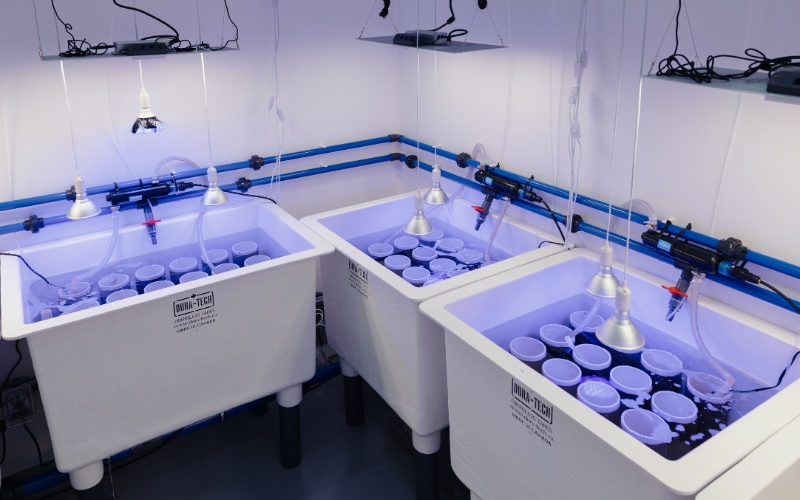
The nursery contains eight independent tanks, each capable of holding 18 seeded spools. The system became fully operational at the end of November, just in time for the first spool seeding.
With hatchery and nursery systems now in place, the project is entering its next phase: outplanting kelp into the ocean. Because kelp is highly seasonal, planting must occur under the right ocean conditions. Near Prevost Island, that window opens in winter, which is why kelp planting is now underway in January 2026.
Each spool will be deployed to farm and restoration sites, where the young sporophytes will grow into mature kelp forests, some capable of reaching up to 20 meters in length over the season.
For corporate partners and sustainability leaders, this work is about investing in the systems that make restoration reliable, scalable, and scientifically grounded.
Hatchery development may not be the most visible part of ocean restoration, but it’s one of the most critical for ensuring long-term seaforestation at scale.
By supporting this infrastructure, partners are helping build the foundation for:
This kind of controlled infrastructure also strengthens monitoring and verification by creating more consistent, traceable inputs from the very start of the restoration process.
And now, with planting season officially underway, those early investments are moving from hatchery to ocean, where sea forests can begin doing what they do best: grow quickly, build habitat, and help restore marine ecosystems.
PREV BLOG