
Mangrove Restoration
Projects

What Is Mangrove Restoration?

Mangrove restoration is the process of helping degraded or lost mangrove ecosystems recover. This effort involves planting and nurturing mangrove trees and other vegetation in coastal zones, which aims to:

A fine-line icon in black showing a house on a cliff and a rock falling down the side due to erosion.

Prevent Erosion

A fine-line icon in black showing a circle of biodiversity including a bird, a fish and a bee.

Enhance Biodiversity

A fine-line icon in black showing a cloud behind a fir tree and an arrow pointing from the cloud towards the tree.

Carbon Sequestration

Mangrove Restoration May Involve:

Planting locally appropriate mangrove species

Supporting natural regeneration

Improving the environmental conditions needed for recovery

Working with local restoration teams and communities

Monitoring planting activity and ecosystem progress

Protecting restored sites from further degradation

The right approach depends on the project location, local ecology, hydrology, land-use pressures, and the needs of surrounding communities. Mangrove restoration should therefore be treated as a long-term ecological process, not simply a one-time planting activity.

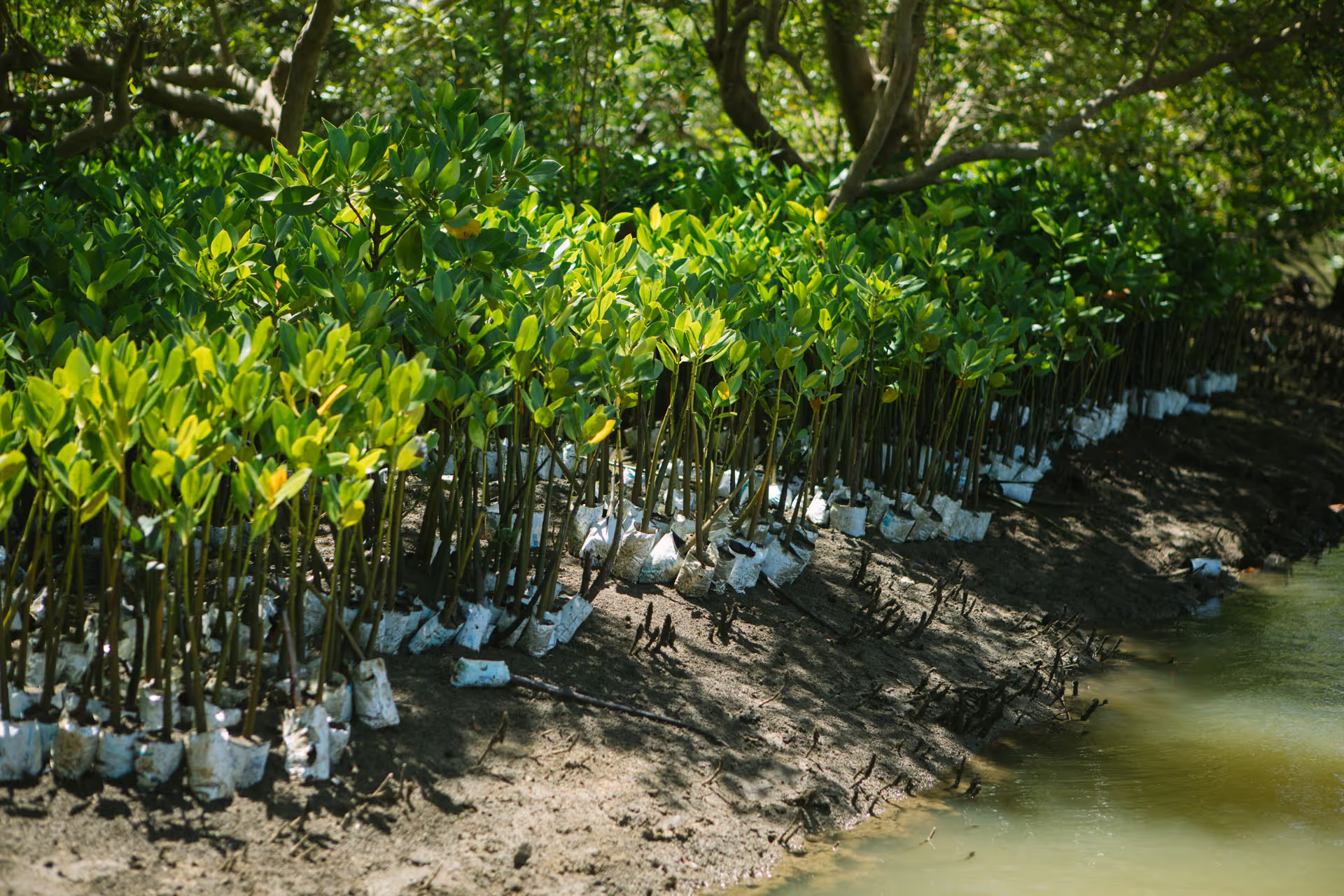
Person in blue planting young mangrove saplings in soil with blurred background.Rows of young mangrove seedlings planted along the muddy edge of a water body.

The Benefits of Mangrove Restoration

“Mangrove forests are one of the world’s most precious resources for people and marine life – and the need to protect them has never been more urgent.”


- Mangrove Action Project

Mangroves cover 75% of the world’s tropical coastlines.1

80% of global fish catch relies on mangroves.2

Our Mangrove Planting Projects in Action

veritree’s portfolio connects businesses with mangrove restoration projects rooted in real coastal environments. Each project has its own ecological conditions, community context, restoration needs, and measurable outcomes.

Eastern Africa

Kenya, Tanzania & Mozambique

Restoring mangrove forests in Eastern Africa to empower coastal communities, break poverty cycles, and provide rich fishing grounds.

View Project Details
Dark arrow pointing right.

Primeira Cruz

Brazil

Restoring Brazilian carbon-rich mangrove estuaries through reforestation to improve the livelihoods of local fishers and create jobs.

View Project Details
Dark arrow pointing right.
Explore All Restoration Types
A white arrow pointing to the right.

Why Mangrove Restoration Matters

Mangrove forests are highly productive ecosystems that support people, wildlife, and coastal environments.

Although they occupy a relatively small portion of the world’s tropical forests, mangroves provide important habitat, coastal protection, water-quality benefits, livelihoods, and climate-related value

Supporting Coastal Protection and Shoreline Resilience

Mangrove roots help hold soil and sediment in place. This can reduce erosion and help shorelines respond to waves, tides, flooding, and severe weather.

Mangrove forests can also act as natural buffers between coastal communities and incoming water. Their roots, trunks, and vegetation help slow wave energy and stabilize areas that might otherwise be more exposed to erosion.

FAO identifies shoreline stabilization, storm protection, sediment trapping, and water filtration among the ecosystem services provided by mangroves.

Providing Habitat for Fish and Wildlife

Mangrove forests create shelter, food, and nursery habitat for a wide range of species.Their partially submerged root systems provide spaces where young fish, crabs, shellfish, and other aquatic species can feed and avoid larger predators. Birds, mammals, reptiles, insects, and plants also depend on mangrove ecosystems.

Supporting Coastal Communities and Livelihoods

For many coastal communities, mangroves are closely connected to food, employment, income, and cultural life.

Local fisheries may depend on the habitat mangroves provide. Communities may also rely on surrounding ecosystems for nutrition, small-scale enterprise, tourism, forest products, and protection from environmental hazards.

Effective mangrove restoration should include the people connected to the landscape. Local knowledge, long-term stewardship, and community participation can all contribute to stronger restoration outcomes.

Mangrove Restoration for Corporate Sustainability

Mangrove restoration can become part of a broader corporate sustainability strategy when it is connected to clear goals and transparent reporting.

Businesses may choose mangrove projects to support:

A fine-line icon in black showing a circle of biodiversity including a bird, a fish and a bee.

Biodiversity and habitat goals

Dark fine line drawing of a earth with a check mark off to the side sitting within a circle.

Climate adaptation initiatives

A fine-line icon in black showing a cloud behind a fir tree and an arrow pointing from the cloud towards the tree.

Blue carbon strategies

A fine-line icon in black of an open hand holding a sapling.

ESG programs

Dark fine line drawing of a handshake.

Corporate social responsibility

Dark fine line drawing of a handshake and a sapling growing from both.

Nature-related commitments

Dark fine line drawing of a side vide of a hand a small hear hovering over the palm

Community impact

Dark fine line drawing of a thumbs up within a speech bubble.

Employee engagement

Dark fine line drawing of a human head & shoulders in a circle with 3 stars above the head.

Customer participation

Sustainability reporting

.custom-form-wrapper .hs-form input, .custom-form-wrapper .hs-form textarea, .custom-form-wrapper .hs-form select { border-radius: 25px !important; border: 1px solid #152227 !important; }